Salem: 503-339-7351
  info@imgclinics.com
  Open Mon Tue Wed Thur Closed Sat & Sun
Decompression Therapy
Spinal Decompression Therapy in Salem, Oregon
A Non-Surgical Approach to Disc, Nerve, Neck and Back Pain
Spinal decompression therapy is a non-surgical, drug-free treatment designed to gently unload selected areas of the cervical or lumbar spine.
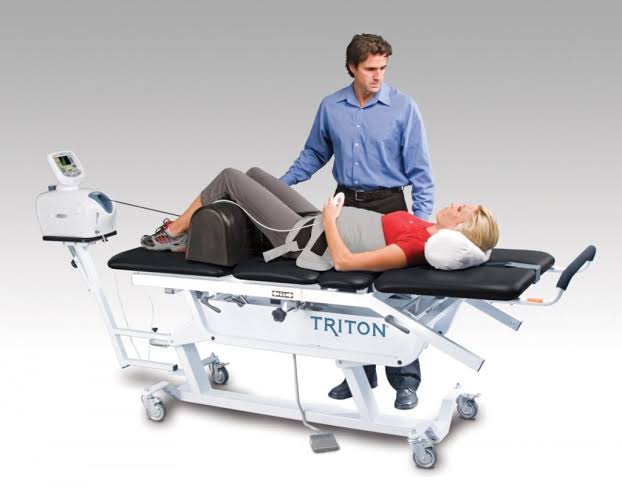
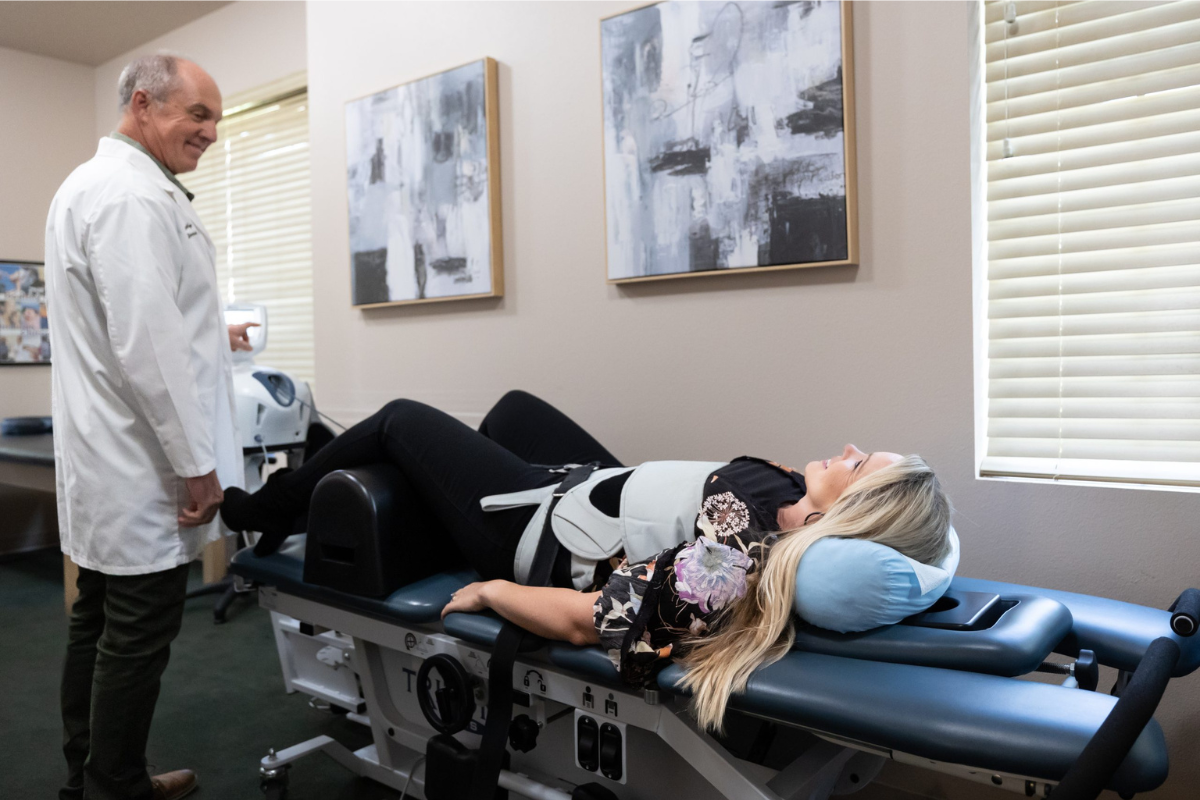
At InterState Medical Group – Disc Centers of Salem, we use the Chattanooga Triton DTS spinal decompression system, a computerized traction platform that allows our doctors to precisely control the amount, timing, progression, and release of traction based on the patient’s condition and tolerance.
The objective is not simply to “stretch the back.”
It is to create a controlled mechanical environment that may help decrease stress on irritated spinal structures, improve movement, and reduce symptoms in appropriately selected patients.
Decompress. Restore Motion. Rebuild Function.
What Does Spinal Decompression Actually Do?
Your spinal discs sit between the vertebrae and act as flexible load-bearing structures.
When a disc becomes irritated, degenerative, bulging, or herniated, nearby joints and nerve roots may also become sensitive.
Spinal decompression applies carefully controlled traction to temporarily reduce compression across selected spinal segments.
Research measuring pressure inside the lumbar disc has shown that vertebral axial decompression can substantially lower intradiscal pressure during treatment. In a Journal of Neurosurgery study, Ramos and Martin found that increasing decompression tension produced progressively lower intradiscal pressures, including pressures below zero in the patients studied.
That does not mean every herniated disc is physically “sucked back into place.”
What it does mean is that controlled unloading can change the mechanical forces acting on the disc and surrounding tissues.
That may help create a more favorable environment for:
- Reduced mechanical irritation
- Reduced nerve-root stress in selected cases
- Improved tolerance to movement
- Reduced muscle guarding
- Improved mobility
- Progression into active rehabilitation
Less Pressure.
Better Movement.
A Better Opportunity to Recover.
The Early Work of Dr. C. Norman Shealy
Dr. C. Norman Shealy, MD, PhD, a neurosurgeon and early pioneer in modern pain management, was among the physicians who investigated vertebral axial decompression as a conservative treatment option for lumbar pain.
In 1997, Shealy and Vera Borgmeyer published “Decompression, Reduction, and Stabilization of the Lumbar Spine: A Cost-Effective Treatment for Lumbosacral Pain.”
Their preliminary clinical study reported that among patients with ruptured or protruding intervertebral discs, a substantial proportion rated their improvement as good or excellent.
One of their frequently cited observations was:
“Sciatica and back pain were relieved.”
Their study also reported good-to-excellent results in 18 of 22 patients overall, including 12 of 14 patients with disc protrusion, using their defined patient-rated outcome categories.
This was an early and relatively small clinical study, so we do not present those percentages as a guarantee of outcome.
What Shealy’s work helped demonstrate historically was something important:
Carefully Controlled Spinal Decompression Deserved Further Study as a Conservative Option for Disc-Related Pain.
What Does More Recent Research Show?
Research since Shealy’s early work has continued to examine traction and decompression for patients with lumbar disc herniation and radicular pain.
A 2020 systematic review and meta-analysis of randomized trials involving patients with imaging-confirmed herniated lumbar discs found that traction produced greater short-term improvements in pain and function compared with sham or no traction. The same analysis did not find sufficient evidence that traction reliably reduces the physical size of a herniated disc.
A later meta-analysis likewise found improvements in pain and disability measures when mechanical traction was incorporated into treatment for lumbar disc herniation and concluded that traction may be useful in conjunction with other physical therapies.
That distinction is important.
At InterState Medical Group, we don’t tell patients that decompression magically “puts the disc back.”
We explain it more accurately:
Decompression Changes the Mechanical Environment.
And for the right patient, that mechanical change may help decrease pain and make rehabilitation more successful.
Why We Use the Chattanooga Triton DTS
Not all traction systems are the same.
We chose the Chattanooga Triton DTS because it gives our doctors much more control than a basic traction table.
The system allows individualized adjustment of:
- Traction force
- Progression of force
- Treatment duration
- Hold and release cycles
- Intermittent or static traction
- Treatment speed
- Pretension
- Cervical or lumbar application
- Patient-specific protocols
This matters because an acute disc patient with significant muscle guarding should not necessarily receive the same treatment parameters as someone with a chronic degenerative condition.
The Machine Does Not Decide the Treatment.
The Doctor Does.
The technology simply allows us to deliver that treatment with greater precision and reproducibility.
Is Spinal Decompression the Same as Ordinary Traction?
They are related, but modern computerized decompression systems allow far greater control over how traction is applied.
Traditional traction may apply a relatively simple pulling force.
Computer-controlled decompression can vary:
- Force
- Duration
- Cycling
- Speed
- Progression
- Relaxation
- Position
The objective is to produce a controlled and tolerable unloading effect while minimizing protective muscle guarding.
That is one reason we invested in the Triton DTS rather than relying solely on basic mechanical traction.
Conditions That May Benefit From Spinal Decompression
Following an examination, spinal decompression may be considered for selected patients with conditions such as:
- Herniated discs
- Bulging discs
- Lumbar disc protrusion
- Cervical disc problems
- Sciatica
- Lumbar radiculopathy
- Cervical radicular symptoms
- Chronic lower back pain
- Chronic neck pain
- Degenerative disc disease
- Certain degenerative joint conditions
- Facet-related pain
- Certain spinal stenosis presentations
- Nerve-root irritation
- Mechanical back pain associated with disc loading
- Recurrent disc-related pain
Not every patient with one of these diagnoses is automatically a decompression candidate.
Diagnosis Matters.
Neurological Findings Matter.
Imaging May Matter.
Patient Selection Matters.
What About Spinal Stenosis?
Spinal stenosis deserves special consideration.
Some patients with stenosis may tolerate certain forms of traction or flexion-based unloading well, while others may have symptoms or structural findings that make another approach more appropriate.
We therefore do not advertise decompression as a universal treatment for spinal stenosis.
We evaluate the patient first.
The same principle applies to neurogenic claudication.
Am I a Good Candidate for Spinal Decompression?
The doctors at InterState Medical Group determine whether decompression is appropriate after reviewing your history, examination findings, neurological status, and available imaging.
You may be a potential candidate if you have:
- Persistent neck or back pain
- Herniated or bulging discs
- Sciatica
- Radiating arm or leg pain
- Disc-related nerve irritation
- Degenerative disc disease
- Certain facet-joint conditions
- Disc-related pain aggravated by compression
- Symptoms that have not responded adequately to simpler conservative care
If you already have an MRI, CT, or X-ray report, bring it with you.
Reviewing existing imaging can help us determine:
- Which spinal level may be involved
- Whether a disc is bulging or herniated
- Whether stenosis is present
- Whether degeneration is significant
- Whether another condition changes the treatment plan
We do not automatically require an MRI for every patient.
But when advanced imaging is clinically indicated, we can refer for it.
Who Should Not Receive Spinal Decompression?
Spinal decompression is not appropriate for everyone.
Depending upon the individual, contraindications or reasons for additional evaluation may include conditions such as:
- Acute spinal infection
- Discitis
- Unstable spinal fracture
- Certain tumors affecting the spine
- Severe osteoporosis
- Significant spinal instability
- Cauda equina syndrome
- Progressive neurological deficit
- Certain recent spinal surgeries
- Abdominal aortic aneurysm
- Pregnancy for certain lumbar traction applications
- Other conditions identified during examination
If we believe decompression is inappropriate or unsafe, we will recommend a different approach or refer you for additional medical evaluation.
Knowing When Not to Treat Is Part of Good Treatment.
What Does Spinal Decompression Feel Like?
Most patients describe treatment as a gentle pulling or stretching sensation.
The patient is comfortably positioned on the Triton DTS table and secured using specialized harnesses.
The system then gradually introduces traction according to the prescribed settings.
Treatment alternates between controlled phases of loading and relaxation depending upon the selected protocol.
Patients commonly report feeling:
- Gentle stretching
- Reduced pressure
- Relaxation
- Increased comfort during treatment
Treatment should not feel forceful or violent.
If the patient’s symptoms change during decompression, the protocol can be modified or discontinued.
Why Muscle Guarding Matters
When the nervous system perceives pain or instability, surrounding muscles may tighten reflexively.
This protective response is called muscle guarding.
Too much traction delivered too quickly may increase guarding rather than decrease it.
One of the benefits of the Triton DTS system is the ability to gradually introduce and vary traction so the patient can remain more comfortable.
Better Relaxation Can Mean Better Tolerance.
And better tolerance allows us to progressively adjust care as the patient improves.
Does Decompression Heal a Herniated Disc?
We prefer a more accurate answer than simply saying yes.
The human body has its own capacity to adapt and heal, and some disc herniations naturally regress over time.
Spinal decompression does not guarantee that a disc will return to its previous anatomical appearance.
What it may do is improve the mechanical environment surrounding an irritated disc and nerve root.
Older CT research demonstrated that lumbar traction could produce measurable changes in some herniated discs during traction, although responses varied according to the location and characteristics of the herniation.
Modern systematic reviews, however, have not established consistent long-term reduction in disc-herniation size from traction alone.
That’s why we focus on the outcome that matters most:
How Are You Functioning?
Decompression Is Only One Part of Recovery
At InterState Medical Group, we do not believe a patient should spend weeks lying on a machine without progressing toward active recovery.
Spinal decompression may be combined with:
- Chiropractic care
- Therapeutic exercise
- Physical rehabilitation
- Soft-tissue treatment
- Therapeutic massage
- Class IV laser therapy
- Electrical stimulation
- Mobility training
- Strengthening
- Stabilization exercises
- Home rehabilitation
The treatment plan evolves as the patient improves.
Reduce Irritation.
Restore Motion.
Rebuild Strength.
Return to Function.
Why Rehabilitation After Decompression Matters
Decompression may help a painful patient tolerate movement again.
But eventually the body must move under its own power.
That is where rehabilitation becomes essential.
Our goal is to progressively restore:
- Mobility
- Core stability
- Muscular endurance
- Spinal control
- Strength
- Movement confidence
- Ability to work
- Ability to exercise
- Ability to perform normal daily activities
Passive care creates an opportunity.
Active Rehabilitation Builds Independence.
Our Goal Is Not Permanent Decompression Care
We don’t want a patient dependent on a machine forever.
Successful conservative care should progressively move the patient toward greater independence.
The sequence is straightforward:
Pain Reduction
↓
Decompression & Mobility
↓
Restore Motion
↓
Build Strength
↓
Restore Function
↓
Independence
Independence Over Dependence. This is what we want for ALL of our patients and practice members.
Spinal Decompression in Salem, Oregon
If you have been diagnosed with a herniated disc, bulging disc, sciatica, degenerative disc condition, or chronic neck or lower-back pain, spinal decompression may be one conservative treatment option worth considering.
The first question is not:
“Do I need decompression?”
The first question is:
“What is actually causing my symptoms?”
That is what we determine first.
Call 503-339-7351 to schedule a spinal decompression evaluation at:
InterState Medical Group – Disc Centers of Salem
1410 Lancaster Dr NE
Salem, Oregon 97301
Bring any existing MRI, CT, or X-ray reports with you.
Advanced Technology.
Careful Patient Selection.
Purposeful Rehabilitation.
Better Movement.
Movement is Our Medicine.
Motion Wins.